Back to Home
FRAM Structure · 8 Levels

The Path to Mental Math Mastery

UCMAS follows the FRAM structure — Foundation · Refine · Ascend · Masters— 8 progressive levels that rewire how your child's brain handles numbers. Forever.

Ages 4–13
8 Levels
2× / week
Global Certification
80+ Countries
30,00,000+ Children
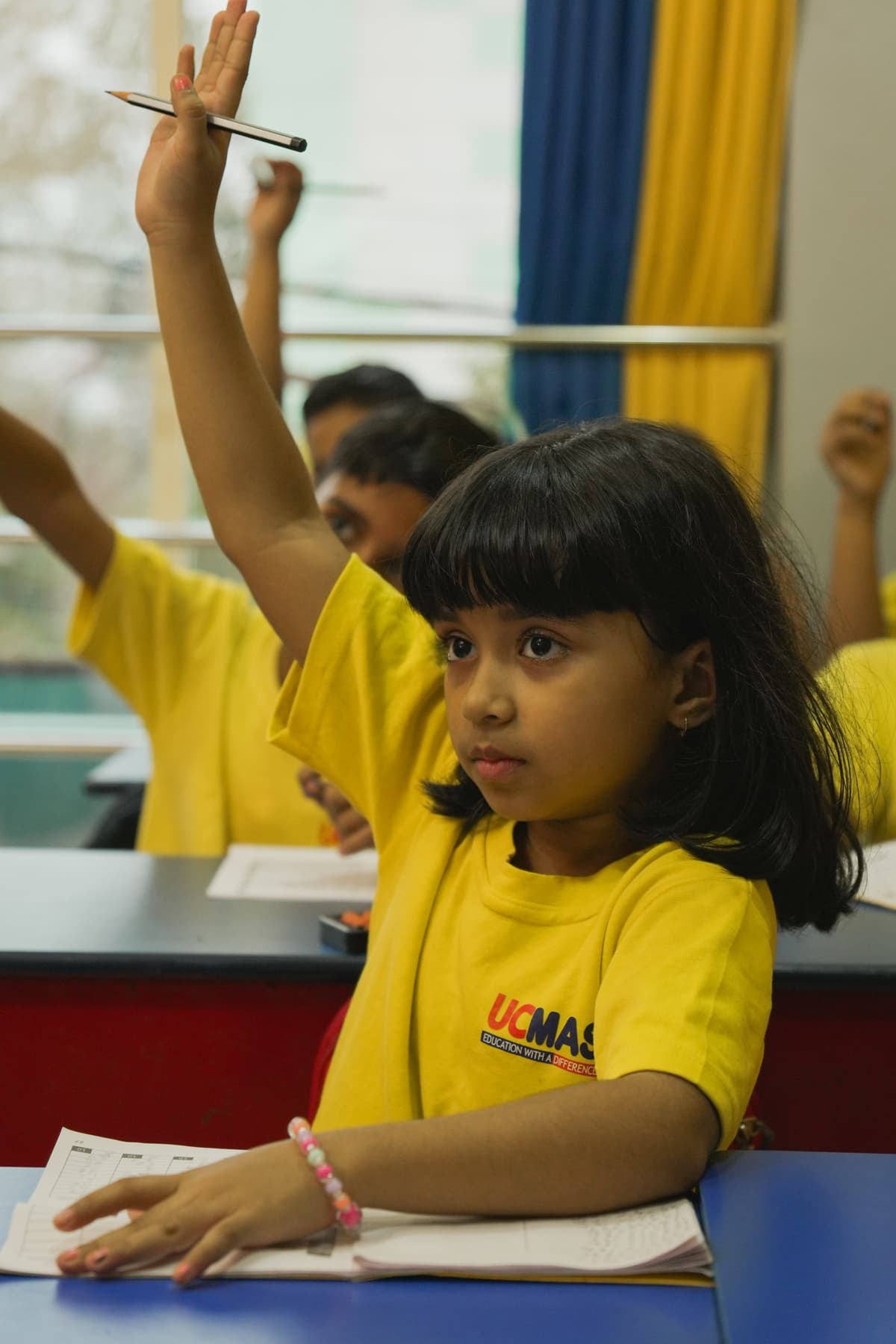
UCMAS students learning abacus mental math
Age Range
4 – 13 yrs
Programme
3.5 – 5 yrs
Global Rank
#1 Abacus
FRAM Structure

Eight Levels. One Transformed Mind.

8 progressive levels across 4 modules. Each builds on the last — no skipping, no shortcuts, total mastery.

F
R
A
M
F
Module
Foundation

Where It All Begins

1Foundation4 Months

Introduction to the Abacus, operating the beads. Basic addition and subtraction with Abacus & Mental Learning games and activities.

2Basic Level6 Months

Building number sense and bead manipulation skills. Students learn to visualize numbers on a base-10 system using countable beads.

3Elementary A6 Months

Progressive addition and subtraction practice. Introduction to speed training and listening exercises.

R
Module
Refine

Sharpening Skills

4Elementary B6 Months

Introduction to multiplication and division with the Abacus. Developing mental visualization techniques.

5Intermediate A4 Months

Strengthening all four operations. Speed calculation drills and auditory processing exercises.

A
Module
Ascend

Rising to New Heights

6Intermediate B4 Months

Complex multi-digit operations. Transitioning from physical Abacus to mental visualization.

7Higher A4 Months

Advanced mental arithmetic with larger numbers. Speed and accuracy training intensifies.

8Higher B4 Months

Refined mental calculation skills. Students begin performing complex operations without the physical tool.

M
Module
Masters

Achieving Mastery

9Advance Level4 Months

High-speed mental calculations with multi-digit numbers. Students solve complex problems in seconds.

10Grand Level A5 Months

Near-complete mastery of mental arithmetic. Students perform calculations of up to 10 digits mentally.

11Grand Level B5 Months

The pinnacle of the UCMAS programme. Students achieve extraordinary speed and accuracy in mental math.

Total programme duration ~3.5–5 years · 2 classes per week · Globally certified at each level

Book Free Trial Class
Learning Science

Built for every kind of learner.

UCMAS is architected around VAK theory — the three proven ways the human brain encodes new information. Every lesson simultaneously engages all three channels.

👁
Visual Learning
See it to believe it.

Visual learners absorb information through pictures, spatial relationships, and patterns. In UCMAS, they track bead positions, watch the abacus in motion, and — most powerfully — close their eyes and see a photographic mental abacus in the mind.

  • Mental abacus visualisation (imaginary abacus)
  • Colour-coded bead & column charts
  • Flash Anzan screen displays
  • Mirror practice & instructor demos
🎧
Auditory Learning
Hear it, process it.

Auditory learners thrive on rhythm, repetition, and verbal instruction. UCMAS Listening Training calls out numbers at speed — students compute entirely in their heads, no visuals. The rhythmic cadence of number sequences becomes the soundtrack for fast, automatic recall.

  • Listening drills — numbers spoken at pace
  • Rhythmic chanting of formulae
  • Verbal self-checking & peer quizzes
  • Call-and-response speed rounds
🖐
Kinesthetic Learning
Touch it, own it.

Kinesthetic learners need to move, feel, and do. The physical abacus is their entry point — every bead push builds neural pathways. Muscle memory from thousands of bead movements makes the transition to mental calculation feel natural and inevitable.

  • Hands-on physical abacus bead manipulation
  • Fine motor drills reinforcing formula memory
  • Speed-building timed finger exercises
  • Tactile number games & bead races

Why all three at once? Research shows that multi-sensory encoding creates stronger, more retrievable memories. A child who sees, hears, and physically manipulates the same number concept retains it 3–5× longer than single-channel instruction.

Proprietary Method

The Six Finger Technique

UCMAS's proprietary finger system maps six precise finger positions to abacus bead values. Each finger has exactly one job — eliminating hesitation and building the motor memory that powers mental calculation.

Because the brain controls each hand through its opposite hemisphere, using both hands simultaneously fires six distinct neural pathways — right-hand fingers activate the left hemisphere, left-hand fingers activate the right. This bilateral stimulation is what makes UCMAS uniquely powerful for cognitive development.

Once the six-finger pattern is internalised, the brain retains a ghosted version. Students “move” invisible beads in their minds — completing complex calculations without any physical tool.

6
Finger positions
2
Hemispheres activated
Numbers computable
Contralateral Neural Activation
Each finger activates a specific brain region in the opposite hemisphere. Six fingers = six neural pathways firing at once — this bilateral engagement is why UCMAS children develop superior cognitive speed.
Right Hand
→ Left hemisphere
Left Hand
→ Right hemisphere
Right Hand · Left Brain
👍
Finger 1 · Right Hand
Right Thumb
activates ↓
🧠 Left Pre-frontal Cortex
Executive function, planning sequences, and focused decision-making
☝️
Finger 2 · Right Hand
Right Index
activates ↓
🧠 Left Post-frontal Cortex
Motor execution, precise fine-motor control and spatial sequencing
🖕
Finger 3 · Right Hand
Right Middle
activates ↓
🧠 Left Parietal Lobe
Numerical processing, quantity representation and arithmetic sense
Left Hand · Right Brain
👍
Finger 4 · Left Hand
Left Thumb
activates ↓
🧠 Right Pre-frontal Cortex
Creative reasoning, mental imagery and visualisation of the abacus
☝️
Finger 5 · Left Hand
Left Index
activates ↓
🧠 Right Post-frontal Cortex
Spatial motor control, pattern recognition and movement coordination
🖕
Finger 6 · Left Hand
Left Middle
activates ↓
🧠 Right Parietal Lobe
Holistic spatial processing, mental rotation and positional memory
How We Train

Six training methods. One complete system.

Each UCMAS class weaves multiple methods together so every child — regardless of learning style — is fully engaged for the entire session.

Speed

Flash Cards

Numbers flash on screen — one after another, very fast. Your child's job: add them all up in their head, with nothing to write on. The faster the flash, the sharper the brain.

Starts slow and speeds up as the child improves. Each level unlocks a faster pace.
Auditory

Listening Training

Numbers are called out loud — nothing to look at, nothing to write. Students compute entirely in their head. Builds incredible focus and the ability to think clearly under pressure.

Trains the brain to hold a running total across 10–20 numbers heard in sequence.
Mental

Mental Abacus

Eyes closed. No abacus. No screen. Students picture an abacus in their mind and move imaginary beads to calculate. This is the superpower UCMAS is famous for.

Introduced from Level 4. Once mastered, mental calculations become faster than a calculator.
Accuracy

Formula Drills

Three simple rules — Friends of 5, Friends of 10, and Big Friends — handle every maths carry and borrow. Students drill these until they happen without thinking.

Mastery of each formula is tested before the child advances to the next level.
Advanced

Competition Training

Timed rounds. Real competition problems. Race-the-clock pressure. Students preparing for district, state, or international championships train in formats matching the UCMAS World Championship.

Optional from Level 5. UCMAS Odisha has produced national finalists.
Assessment

Level Tests

Before moving up, every child sits a formal test — speed, accuracy, and formula knowledge. Pass, and they earn an internationally recognised UCMAS certificate. No shortcuts.

Certificates are issued by UCMAS International, valid across 86 countries.
Measurable Outcomes

Skills that go far beyond maths.

Backed by peer-reviewed research from Harvard, Stanford, Zhejiang University and the Chinese Academy of Sciences.

Working Memory
+45%

They hold and juggle more numbers in their head at once — which spills over into better reading, science, and problem-solving.

Average child40
UCMAS child58
memory score
Processing Speed
4–6×

They solve arithmetic problems 4–6× faster than peers the same age who haven't trained.

Before UCMAS15
After UCMAS75
problems / min
Concentration Span
+38%

Sustained mental calculation builds the ability to focus deeply — not just in maths, but in every subject.

Before training42
After training58
focus score
Academic Confidence
94%

9 in 10 UCMAS students report feeling noticeably more confident in maths class within just 3 months.

Before UCMAS30
3 months in75
confidence %
Classroom Performance
Top 10%

UCMAS graduates consistently rank in the top decile of their class across all STEM subjects.

Average peer50
UCMAS graduate73
class percentile
Competition Ready
80+ countries

Students compete at district, state, national, and international UCMAS championships every year.

No training0
UCMAS trained65
competition score
Why UCMAS?

Not just tuition. Brain training.

Regular maths tuition fixes today's homework. UCMAS rewires how the brain handles numbers — for life.

✦ UCMASRegular Tuition
🎯Goal
Build mental horsepower for life
Cover syllabus, pass tests
🧠Method
Abacus → mental visualisation → mastery
Drill current school exercises
Pace
Child's developmental readiness
School term calendar
📈Outcome
Long-term brain rewiring (MRI-confirmed)
Short-term grade uplift
🏅Certification
8-level global certificate, 86 countries
None
🏆Competitions
District → National → International
None
Quick Facts

Everything you need to know

⏱️
Level Duration
Approx. 3–6 months for each level
📅
Weekly Classes
2 hours per week
📝
Prerequisites
Basic ability to recognize and write the numbers 1–100 forward and backwards
🎓
Certified By
UCMAS International · Chinese Zhusuan Association (CZA) · GAAMA
Free Trial Class

Let your child try one class for free.

A 45-minute interactive session with a certified UCMAS instructor. No commitment, no fee. Your child will love it.

No cost, no commitment
Certified instructor
Weekend batches available
Odisha & NE India
Age
4 – 13 years
Duration
45 minutes
Location
Your nearest centre
Book My Child's Free Trial

Classes run across Odisha & North East India · We respond within 4 hours

Proven by Science

What the research actually shows.

Scientists from some of the world's top universities have studied what happens to children who go through UCMAS training. The findings are remarkable — and they are written in plain language below, so every parent can understand them.


Harvard
Stanford
UCSD
Joint Collaborative Research Programme
Harvard · Stanford · UC San Diego
🔬 Multi-University Joint Study
UCMAS International Research — Cognitive Development
UCMAS Harvard-Stanford-UCSD Research

A landmark collaborative study examining the cognitive benefits of abacus-based mental arithmetic training on children's intellectual development.

Published / conducted by
Harvard UniversityHarvard University
Stanford UniversityStanford University
University of California, San Diego (UCSD)University of California, San Diego (UCSD)
How many numbers can your child hold in their head at once?
UCMAS children can hold up to 4 times more numbers in their head at once — compared to children with no training.
This is called working memory — the mental space your brain uses to process information. The more space you have, the faster and better you think.
Most adults & regular children
No special training
4
UCMAS children (early stage)
After beginner levels
5
UCMAS children (middle stage)
After intermediate levels
7
UCMAS children (advanced stage)
Top performing students
16
What this means for your child: A bigger mental workspace means faster problem solving, better reading comprehension, and stronger performance across all school subjects — not just mathematics.
Read the full research paper
University of Khartoum
Sudan National Research Centre
University of Khartoum
📊 Longitudinal IQ Study · 42 Years
National Intelligence & Abacus Training Research
The Increase in Intelligence in Sudan

Research demonstrating measurable increases in intelligence scores among Sudanese children who underwent UCMAS abacus training programmes.

Published / conducted by
University of KhartoumUniversity of Khartoum
Sudan National Research Centre
Does abacus training actually make children smarter over time?
Intelligence scores rose by 12 points over 42 years — a rise directly linked to structured abacus training programmes.
This was a nationwide study in Sudan tracking how intelligence scores changed as more children enrolled in abacus-based training. The improvement was consistent across every decade measured.
196483197486198489199492200696
Average intelligence score by year
+12
Intelligence
points gained
42
Years of
data tracked
What this means for your child:Intelligence is not fixed at birth. With the right structured training during the right age window, a child's cognitive ability measurably increases — and UCMAS children in this study showed exactly that.
Read the full research paper
Zhejiang University
Chinese Academy of Sciences
Zhejiang University
🧠 Neuroimaging · Brain Network Study
Functional Brain Network Topology Research
The Effects of Long-term Abacus Training on Topological Properties of Brain Functional Networks

Neuroimaging study revealing how prolonged abacus training reshapes brain functional network topology, enhancing neural connectivity and cognitive efficiency.

Published / conducted by
Zhejiang UniversityZhejiang University
Chinese Academy of SciencesChinese Academy of Sciences
Do UCMAS children perform better in school mathematics?
UCMAS children scored nearly 9 points higher in mathematics tests — compared to children who had no abacus training.
This was a study of 144 children where scientists also scanned their brains using special imaging technology. The UCMAS children not only scored higher — their brains were also working more efficiently.
48
Children with no training
57
UCMAS children
+9 points
Higher mathematics score compared to children with no training
144
Children studied using brain scanning technology
More efficient
UCMAS children's brains used less effort to solve harder problems
What this means for your child: UCMAS children do not just get better at maths — their brains literally rewire to become more efficient. They solve harder problems using less mental effort, leaving more brainpower available for everything else.
Read the full research paper
Beijing Normal University
Chinese Academy of Sciences
Beijing Normal University
⚡ Cognitive Neuroscience · fMRI
Neural Systems & Cognitive Functions Research
The Effects of Abacus Training on Cognitive Functions and Neural Systems in Humans

Comprehensive investigation into how abacus training impacts cognitive functions and associated neural systems, providing evidence for whole-brain development.

Published / conducted by
Beijing Normal UniversityBeijing Normal University
Chinese Academy of SciencesChinese Academy of Sciences
By how much does UCMAS training improve a child's memory?
UCMAS children can remember more than twice as many numbers in a row — a skill that transfers directly to reading, science, and problem solving.
Researchers tested how many numbers in a sequence a child could hold in their short-term memory. This ability — called digit span — is one of the most reliable measures of overall memory strength.
Children with no training — can remember 7 numbers in a row
1
2
3
4
5
6
7
8
9
10
11
12
13
14
15
UCMAS children — can remember 15 numbers in a row
1
2
3
4
5
6
7
8
9
10
11
12
13
14
15
Gold circles show the extra memory capacity that UCMAS training builds on top.
20 days
is all it takes to see the first measurable memory improvements
3 years
of training creates lasting changes in how the brain is structured
3,185
children across multiple studies confirmed these findings
What this means for your child: Better memory means better grades — in every subject. Children who remember more during a lesson, a test, or a conversation have a real and lasting advantage that stays with them for life.
Read the full research paper
Harvard University
Center on the Developing Child
Harvard University
★ Landmark Policy Paper · 2007
National Scientific Council on the Developing Child — Working Paper No. 5
The Timing and Quality of Early Experiences Combine to Shape Brain Architecture

The landmark Harvard policy paper establishing that the window of opportunity for higher cognitive development extends well beyond age 3 — and that early, structured enrichment during sensitive periods produces lasting improvements in brain architecture. Directly underpins the UCMAS 4–13 age window.

Published / conducted by
Harvard UniversityHarvard University
National Scientific Council on the Developing Child
Why does starting between ages 4 and 13 give the highest return on investment?
Every rupee invested in your child's brain between ages 4 and 13 returns more than any education or training investment made later in life.
This isn't opinion — it's an economic finding from Harvard. The brain is most “modifiable” in early childhood. The same investment in an older child or adult simply does not produce the same results. The window closes, and the cost of missing it never fully disappears.
✦ UCMAS ZONE ✦Cost of waitingAge 0–3Age 4–13(UCMAS)SchoolAdultReturn on investment →
13×
Return for every ₹1 invested in early childhood education vs adult training
Age 4–13
The UCMAS window captures the highest-return phase of brain development
Permanent
Skills built during sensitive periods encode into brain architecture — they don't fade
“It is more effective and more efficient to get things right the first time than to try to fix them later. The convergence of neuroscience and economics tells us that the clock is always ticking, and the costs of ignoring problems keep rising.”
— Harvard Center on the Developing Child, Working Paper #5 (2007)
What this means for your child: Enrolling in UCMAS between ages 4 and 13 is not just a tuition fee — it is a high-return investment in brain infrastructure that pays dividends across every subject, every exam, and every career decision your child will ever face.
Read the full research paper

Complete Reference Bibliography

Every claim on this website is grounded in peer-reviewed science. Below is the full set of research papers that inform our programme design, age-window recommendations, and improvement metrics.

1
UCMAS Harvard-Stanford-UCSD Research
Harvard University · Stanford University · University of California, San Diego (UCSD)

A landmark collaborative study examining the cognitive benefits of abacus-based mental arithmetic training on children's intellectual development.

2
The Increase in Intelligence in Sudan
University of Khartoum · Sudan National Research Centre

Research demonstrating measurable increases in intelligence scores among Sudanese children who underwent UCMAS abacus training programmes.

3
The Effects of Long-term Abacus Training on Topological Properties of Brain Functional Networks
Zhejiang University · Chinese Academy of Sciences

Neuroimaging study revealing how prolonged abacus training reshapes brain functional network topology, enhancing neural connectivity and cognitive efficiency.

4
The Effects of Abacus Training on Cognitive Functions and Neural Systems in Humans
Beijing Normal University · Chinese Academy of Sciences

Comprehensive investigation into how abacus training impacts cognitive functions and associated neural systems, providing evidence for whole-brain development.

5
The Timing and Quality of Early Experiences Combine to Shape Brain Architecture
National Scientific Council on the Developing Child (2007). Working Paper No. 5. Harvard University.

The landmark Harvard policy paper establishing that the window of opportunity for higher cognitive development extends well beyond age 3 — and that early, structured enrichment during sensitive periods produces lasting improvements in brain architecture. Directly underpins the UCMAS 4–13 age window.

6
Effects of Abacus Training on the Intelligence of Sudanese Children
University of Khartoum · Sudan Ministry of Education

Empirical study measuring the impact of structured abacus training on intelligence metrics among school-age children in Sudan.

7
Mental Abacus: The Effect of Abacus Training on Chinese Children's Mental Calculation
Stigler, J.W. (1984). Cognitive Psychology, 16(2), 145–176.

The landmark study establishing mental abacus as a genuine cognitive tool. Stigler demonstrated that abacus-trained children form and manipulate a vivid mental image of the abacus during calculation — a fundamentally different (and superior) cognitive strategy to verbal counting.

8
Learning Mathematics in a Visuospatial Format: A Randomized, Controlled Trial of Mental Abacus Instruction
Barner, D. et al. (2016). Child Development, 87(4), 1146–1158.

The most rigorous randomised controlled trial of abacus instruction to date. 204 children were randomly assigned to abacus or control groups. Abacus children showed significant advantages in arithmetic, working memory, and spatial reasoning — confirming causal rather than correlational benefits.

9
Representing Exact Number Visually Using Mental Abacus
Frank, M.C. & Barner, D. (2012). Journal of Experimental Psychology: General, 141(1), 134–149.

Reveals the mechanism behind mental abacus: expert users maintain a precise visual-spatial representation of the abacus in working memory. This visual number representation allows calculations that bypass the language system entirely — enabling extraordinary speed and capacity.

10
Neural Correlates of Serial Abacus Mental Calculation in Children
Chen, F. et al. (2006). Neuroscience Letters, 403(1–2), 46–51.

Brain imaging study showing that abacus-trained children recruit visuospatial brain regions (rather than language areas) during mental arithmetic. This whole-brain engagement is the neurological basis for the superior performance and memory capacity seen in UCMAS students.

11
Working Memory: Looking Back and Looking Forward
Baddeley, A. (2003). Nature Reviews Neuroscience, 4(10), 829–839.

The definitive reference on working memory — the mental workspace that abacus training expands. Baddeley's model explains why children with larger working memory outperform peers across all school subjects, not just mathematics.

12
Executive Functions
Diamond, A. (2013). Annual Review of Psychology, 64, 135–168.

Comprehensive review showing that executive functions — inhibitory control, working memory, cognitive flexibility — are the strongest predictors of academic success. These are precisely the skills that UCMAS training systematically develops across ages 4–13.

13
Neuroplasticity: Changes in Grey Matter Induced by Training
Draganski, B. et al. (2004). Nature, 427(6972), 311–312.

Landmark Nature paper proving that skill training physically changes brain structure. Grey matter density increases measurably after training — providing the neurological proof that abacus practice doesn't just build skills, it physically rewires the developing brain.

14
Sensitive Periods in the Development of the Brain and Behavior
Knudsen, E.I. (2004). Journal of Cognitive Neuroscience, 16(8), 1412–1425.

Establishes the neuroscience of sensitive (critical) learning periods — windows where the brain is especially receptive to specific types of input. The 4–13 age window used by UCMAS maps directly onto the sensitive period for mathematical and visuospatial learning.

15
Critical Period Plasticity in Local Cortical Circuits
Hensch, T.K. (2005). Nature Reviews Neuroscience, 6(11), 877–888.

Defines the cellular mechanisms that open and close critical learning periods in the brain. Hensch's work explains why early training produces stronger, more durable results than equivalent training started later in life — the scientific basis for starting UCMAS by age 7.

UCMAS is built on decades of scientific research. Every method we teach, every level your child progresses through, and every skill they build has been tested and validated by researchers at some of the most respected universities in the world.

Continue Exploring
Student ResultsSee the outcomes this curriculum produces.View →Events & CompetitionsWhere students put their FRAM levels to the test.View →About UCMASOur story and the people behind the programme.View →Start a FranchiseBring this curriculum to your city.View →
Free Trial Class · No Cost · No Commitment

Your child's brain is at its peak right now.

Ages 4–13 is the golden window for whole-brain development. The UCMAS programme builds mental speed, deep focus, and lasting confidence — skills that compound for life.

🎯
45-minute demo class
Your child experiences the UCMAS method live — no pre-knowledge needed.
📞
We call within 24 hours
Our centre coordinator confirms your slot and answers every question.
🏆
Zero pressure, zero cost
The trial is completely free. Enrol only if you love what you see.
🌍
30,00,000+ children
worldwide have already joined UCMAS
45,000+ Odisha & NE families enrolled
★★★★★ rated by parents · Since 1993
Free · Takes 2 minutes

Book your child's free trial class

Fill in the short form below. Our centre coordinator will call within 24 hours to schedule a time that works for you.

About you & your child
Parent or guardian filling this form
The child who will attend the trial
Programme is for ages 4 – 13
We call or WhatsApp to confirm your slot
Contact & location
We send you a confirmation email after booking
We find your nearest UCMAS centre

🔒 No spam · No commitment · Your details stay private

Chat on WhatsApp